October 16, 2026
Creusabro® for recycling machinery - Wear resistant steel for demanding applications
By Ece Hülkü - UnionStahl

- What’s Happening ?
- Creusabro® for recycling machinery - Wear resistant steel for demanding applications
Creusabro® for recycling machinery - Wear resistant steel for demanding applications
Creusabro® 8000 provides a durable solution for highly wear-intensive components in recycling and shredding machinery. Its combination of wear resistance, toughness and processability helps components withstand abrasive materials, impact and mechanical loads. Thanks to the TRIP effect, the steel surface can work harden during operation. The material can be cut, formed, machined and welded into customized, ready-to-install parts. A practical application in tool discs demonstrates its suitability for demanding recycling environments and weight-optimized designs.
When wear is a major challenge
Recycling machines are exposed to high levels of abrasive wear and mechanical loads during daily operation. During shredding and processing, hard and abrasive materials come into contact with machine components. At the same time, components are also exposed to impact loads and varying mechanical forces.
Components that come into direct contact with the feed material or are directly involved in the shredding process are subject to particularly high loads. These applications require materials that combine high wear resistance with sufficient toughness and suitable processing properties.
Creusabro® has been developed for demanding wear applications and is suitable for a wide range of components subject to high loads in recycling and shredding machines.
Creusabro® for Abrasive Wear and Mechanical Loads
In recycling applications, components are often exposed to different types of loads at the same time. Abrasive materials cause continuous wear, while hard particles in the feed material can generate additional impact loads.
Creusabro® combines high wear resistance with good toughness, making it suitable for applications that require both resistance to wear and sufficient resistance to mechanical loads.
An important feature of Creusabro® is its metallurgical concept based on the TRIP effect (“Transformation Induced by Plasticity”). During operation, plastic deformation can cause the surface of the material to work harden. Depending on the specific loading profile and operating conditions, the surface hardness can increase by approximately 70 HB. The actual degree of work hardening, however, depends on the individual application and the specific loading conditions.
Another important consideration is processability. Wear components for recycling machines are often custom manufactured according to the specific design and installation requirements. Creusabro® can be processed into cut-to-size parts, edged and machined components and welded assemblies.
Creusabro® also offers good resistance to thermal loads. Creusabro® 8000 can be used at temperatures of up to approximately 450 °C.
Creusabro® 8000 in Practice: Application in Recycling Machines
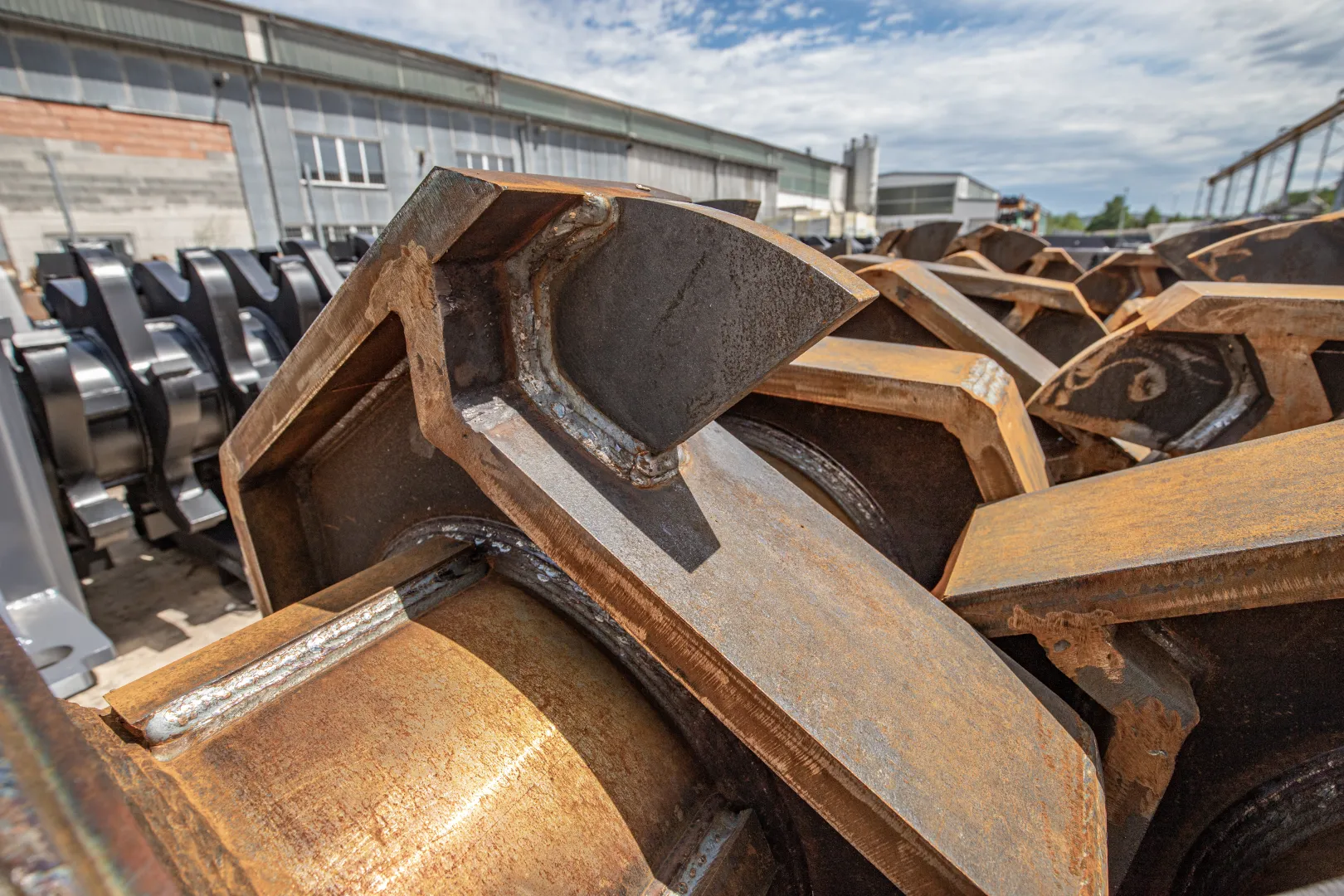
A manufacturer of mobile and stationary recycling machinery uses Creusabro® 8000 specifically for highly wear-intensive components. One example is the tool disc, which operates directly in the shredding process and is exposed to abrasive materials as well as mechanical loads.
Creusabro® 8000 is supplied with a delivery hardness of approximately 430–500 HB. During use, the surface may undergo further work hardening due to the TRIP effect. The hardness that can be achieved depends on the specific operating conditions and the load profile; hardness values of approximately 470–540 HB are specified for the material within its operating rangeThe tool discs are manufactured from Creusabro® 8000, cut to the required geometry and further processed. A welding robot is used for the subsequent fabrication. Robotic welding enables reproducible welding processes and consistent manufacturing quality.
The project also includes other components of the recycling machine, including quick-change cassettes and secondary cutting bars. These are manufactured from S355 and are also robotically welded. The different materials are selected according to the respective function and loading conditions of the components.
Creusabro® 8000 is therefore used specifically where the high wear resistance of the material provides a technical advantage – particularly in the tool discs operating directly in the shredding process.
Especially in mobile recycling machinery, the high wear resistance of Creusabro® can support weight-optimized designs.
UnionStahl supports the project as an application and manufacturing partner, from processing the Creusabro®-plates through to the robotic fabrication of the components and welded assemblies.
The case study demonstrates how Creusabro® 8000 can be specifically applied to highly wear-intensive areas of recycling machinery and processed into finished components using modern manufacturing technologies.
From Creusabro® Plate to the FInished Component
Creusabro® applications range from simple cut-to-size parts to complex, ready-to-install components.
Depending on the component, different manufacturing processes may be used:
- Ox-fuel cutting
- Laser cutting
- Beveling
- Mechanical processing
- Forming
- Welding
The key is to tailor the processing to the specific component geometry and application. This allows Creusabro® to be processed into customized wear components and assemblies according to the requirements of the intended application.
Conclusion: Creusabro® for Demanding Recycling Applications
The case study demonstrates the targeted use of Creusabro® 8000 in recycling technology – particularly for tool discs exposed to high abrasive and mechanical loads during the shredding process.
Where abrasive materials and mechanical loads act on machine components, Creusabro® provides a material solution that combines high wear resistance, good toughness and good processing properties. The TRIP effect enables the surface of the material to work harden during operation, with the actual degree of work hardening depending on the specific loading conditions.
This makes Creusabro® suitable for components where the combination of wear resistance, load-bearing capacity and manufacturability is critical.